Is study of Nyaya at an introductory level useful?

December 11, 2025

Rohit Dhankar

A participant (not mentioning name because I have not taken permission) in Nyaya-sah-adyayan WhatsApp group wrote the following:

  1. I have a question (and believe me I have no mischief in mind) where is this knowledge (knowledge of Nyay Darshan) going to benefit us in our practical (day to day) life and how?
  2. Why should a learner invest time and money on it?
  3. I am an Educator (if not an Educationist) and my main “Business is to do workshops for Teacher’s motivation, Teacher’s commitment, teachers’ style of teaching (let’s call it teaching methodology) and to a little extent ‘Pedagogy’.
  4. So how a person like me is going to get benefitted by this new knowledge?

My response

My response is as follows and believe me I do not interpret it as mischief and responding without any mischief in my mind. 

The short answer:

“No benefit. And one who sees no benefit should not waste effort, energy and money”.

Long answer: (be patient and read):

An understanding of nature of knowledge is central to an educator. Education is primarily concerned with acquisition, creation, critiquing, examining, and using knowledge. The questions of “what is knowledge?”, “How it is generated?”, “How is it examined?” etc. are of fundamental importance for an educator. One hardly needs to argue that knowledge is required in all human actions. Vatsyayana claims right in the beginning of his Nyaya-Bhashya:
“Successful activity (samartha-pravrtti) results when the object (artha) is cognised by the ‘instrument of valid knowledge’ (pramäna). Hence the instrument of valid knowledge is invariably connected with the object (arthavat).
There is no cognition (pratipatti) of object (artha) without the instrument of ‘Valid knowledge’; without cognition of object there is no successful activity. On being aware of the object with the help of the instrument of knowledge, the knower wants either to get it or avoid it. His specific effort (samiha), prompted by the desire of either getting or avoiding (the object), is called activity (pravrtti), whose success (samarthya), again, lies in its invariable connection with the result (phala).”

Plato in Theaetetus 201c–201d (Translation: Benjamin Jowett) claims:
“For true opinions, as long as they remain, are a fine thing and all they accomplish is good; but they are not willing to remain long, and they escape from a man’s mind, so that they are not worth much until one ties them down by an account (logon): and this, my friend, is recollection. When they are tied down, in the first place they become knowledge, and then they remain in place. That is why knowledge is more honourable and excellent than right opinion: because bound by reason.”
Before coming to this passage Plato (Socrates in the dialogue) is talking about uses of true opinion in achieving one’s ends. Vatsyayana is making the same point. Umpteen number of philosophers are making the same point again and again. In common day-to-day activities of life we use knowledge all the time. Even in making a cup of tea one uses knowledge of heat, how to control the source of heat, how long water needs to be boiled, how much tea leaves and sugar, and so on. The success of making good tea depends on all this knowledge.
Vatsyayana says true cognition or knowledge depends on pramans, Plato says it requires reasons. In day-to-day life we seek grounds for accepting any piece of information; even if it is as mundane as what is the market rate of wheat today. Enquiry about grounds is to assure ourselves that the information provided is reliable; it is asking pramanas or reasons. Thus, knowledge and reasons behind it are of utmost importance.
Now there are two questions: 1. Is there unanimity in matters of knowledge and acceptable reasons or pramanas or methos? And 2. Do I want to be autonomous in deciding matters of knowledge or want to live on borrowed knowledge? The first one is concerned with having at the least reasonable grounding in understanding knowledge; and the second one about my autonomy as a human being.
There are multiple systems of epistemology, the discipline which discusses knowledge. They all have strong agreements on some points and equally strong disagreements on some others. They give different definitions, criteria and methods of examination of knowledge, and persepctives. If a teacher knows about more than one such systems s/he is more likely to think critically and clearly; and also, to be able to help her/his students in the same.
Nyaya is an alternative way of looking at knowledge to the generally studied western epistemology. It has a particular penchant for clarity and precision, defining and then examining propositions. It has developed ways of elaborating arguments and communicating to others. These ideas and methos add to our understanding of knowledge and its ways, often provide criteria to critically examine concepts and claims made in the western epistemology, and provide substance to be examined through the ideas and methods of western epistemology. Thus, depend and broadens our perspective.
This should help one develop critical thinking, so much praised these days without really understanding what exactly it might be. The table below gives a tentative comparison between Nyaya’s ways of knowing and critical thinking, put forward more as an exercise in thinking than as a final conclusion. I do not have time to translate it into English, thus copying here in Hindi as it is:
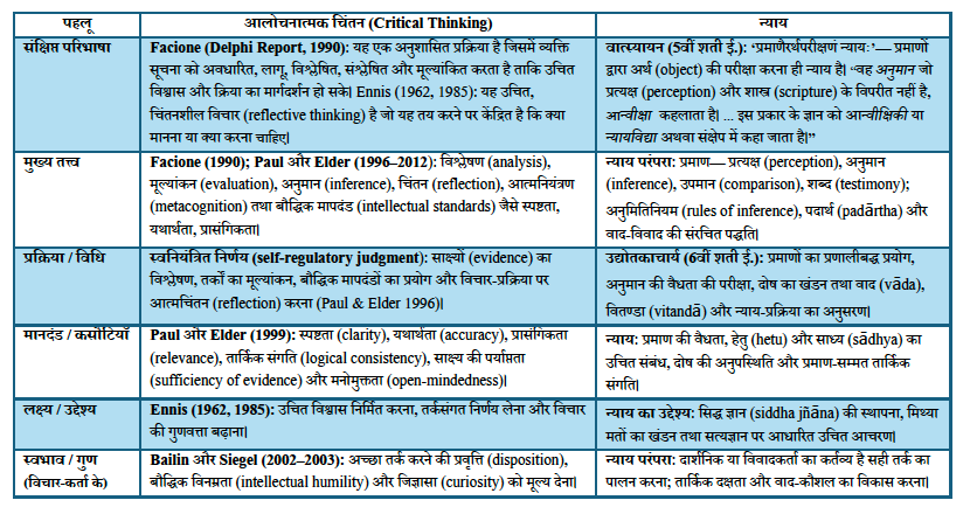
One can go on and on on this issue. To the participants in this study I would say: better collect all the fliers posted as advertisements which duped you into this course to waste your money and time, and examine those numbered 1, 2 and 4. Also read again the introductory text given for the sah-adhyayan, right in the first session.
Can it help in, say, improving teaching methodology? Depends on (1) how well one understands Nyaya, (2) how well connected and consciously guided by theory his/her methodology is, (3) how conscious s/he is about having proper reasons for whatever she does in the classroom. To an activity cruncher and ready-made solution seeker it can give absolutely no help. To a conscious autonomous teacher it should. But, remember being autonomous is painful and dangerous.
Example 1: We all talk about leaving 2–5-year-old children much time for free exploration and play. Why do we recommend that? Common half understood answer is “children learn through play”. This is a mugged-up sentence which most of those who often repeat it cannot explain if one asks: what do they learn? How do you know? What is the use of what they learn? In western epistemology the idea of Knowledge by acquaintance gives one theoretical vocabulary and understanding of how sensory experience is basis of all knowledge and how it is connected with later development of skills and Propositional Knowledge. Similarly, understanding of Indriyas, their role in pratyaksha, the relationship between pratyaksha->sansakar->pramanas provides ability to articulate and think about those reasons. Which should help is choosing right kind of ‘free exploration’ for children at different stages of development. Aurobindo’s emphasis on sharpening sensory equipment for development of ideas and intelligence seems to come more or less directly from his understanding of indriyas and manas, and their role in knowledge formation.
Example 2: The understanding of anumana and difference between swartha and parartha anuman should directly help in spotting students’ difficulties in understanding as well as one’s articulation of explanation. But that we can understand when first we have studied anumana.
One can multiply these example with more detail and clarity, and we will do that in the course of this study as we progress. But at this stage, hardly having studied five concepts of Nyaya one should not attempt that.
But who can draw these benefits from studying Nyaya?
Anyone who puts in efforts and tries to understand. All efforts of using one’s mind and reason seriously even on completely unjustified and patently wrong disciplines will necessarily result in discipline of mind, rigorous use of logic, proper ways of reasoning and systematic thinking. I claim that serious and deep study of even astrology and palmistry will result in these “benefits of mind”, even if no “benefits of content”. However, many people do not understand the value of “benefits of mind”, one can see an example in Gandhi’s claim that study of geometry, astronomy, and geography helped him in nothing. (Hind Swaraj, chapter XVIII)
For whom will it be difficult to gain anything useful?
Let me begin by quoting Winch (last chapter in his Philosophy of Human Learning): “If one does not respect what one is to learn, or recognise the efforts that have gone into its creation and development, then success is unlikely.” Thus, attempts to study Nyaya (or anything) with a disdain for it will almost never result in good understanding of the subject and without good understanding its benefits will remain elusive. But “respect” here does not require an assumption of its truth or its benefits etc. in advance. All it requires is suspension of the judgment that “it is useless” or that “it is of great use” or that “I can understand whether X is useful without first knowing X”. Which means one has to enter with an open mind, with patience to draw a conclusion when one has learnt enough. A child who first wants to know the benefits of learning counting without knowing counting will never calculate even the area of his room.
Drawing benefits from study of Nyaya or anything written in Sanskrit centuries ago is very difficult without first studying it. Even its proper study is very difficult due to biases created by our education system. Anything written in Sanskrit is seen as archaic, or ponga-panthi or stone-age creation without knowing it. People will find tvak (त्वक्) as stone age without knowing that ‘touch’ comes from tvak or at the least has the same stone-age root. This disdain will strop proper and fair understanding, exactly as over-whelming respect or bhaktibhav will stop proper examination. Thus, entering into it with balanced open mind, open eyes and remanning patient till one has sufficient information to base one’s conclusions on is the key.
To re-emphasize the point: one cannot understand usefulness of a branch of knowledge without knowing what it happens to be. Yes, by asking others whom one believes or by asking a guru one can make an opinion about usefulness of anything. But that is more of an assurance at the best and indoctrination at the worst; not ‘understanding proper’. And that is why there is a contradiction between my “short answer” and “long answer”. Without knowing X, it is not possible to explain usefulness of X.
That is why the Sanskrit people had this concept of ‘Anubandh Chatushthay’ if you remember. They want to talk about the subject of a shatra, then relationship of the book wirth that Shastra, then prayojan of it’s study and then of being Adhikari. That may motivate people to study it. If one does not see prayojan one will find no inclination to study it. So, think if you have a prayojana which may be helped by this.


Nyaya as a Philosophy of Public Reasoning

September 30, 2025

Rohit Dhankar

Public Reason

The idea of public reason in the current debates is mostly invoked in connection with political and moral issues which have political implications. It is considered necessary for democracy. This strong emphasis on its legitimate space only in political deliberations limits the scope, constituency, and content of public reason. Rawls limits it to the “constitutional essentials and matters of basic justice” (SEP), thereby not even covering the whole sphere of public relationships where citizens exercise power over each other. Similarly, the constituency (the group of people) covered by the Rawlsian idea are the “reasonable persons” (SEP). Reasonable persons are those who are “ready to propose principles and standards as fair terms of cooperation and to abide by them willingly, given the assurance that others will likewise do so. Those norms they view as reasonable for everyone to accept and therefore as justifiable to them; and they are ready to discuss the fair terms that others propose” (Rawls 1996, 49). Second, who “accept their consequences for the use of public reason in directing the legitimate exercise of political power in a constitutional regime” (Rawls 1996, 54). [Interestingly, the people involved in debates in Indian forums—be that the parliament, the legislatures of states, or the mass media—will almost all fail both Rawlsian criteria!]

The content of public reason, it seems, should include:

  1. Some basic political values like the idea of equal basic liberties; the idea of equality of opportunity.
  2. Guidelines of enquiry which should include principles of reasoning and rules of evidence to determine how substantive principles included in point one are to be applied. (SEP, Rawls)

According to a more inclusive view of constituency, based on Habermas’ view “the normative content of public reason is not something that is determined via philosophical analysis or argument. Rather, philosophy provides a set of ideal rules or guidelines for the conduct of public reasoning. The ideal guidelines for public reasoning would ensure that the discussion is inclusive, public, and free from any internal or external coercion,” and leave the normative content to be determined by the public reasoning itself.

In this view, selectively summarized from the Stanford Encyclopedia of Philosophy, public reason is seen in a technical sense, primarily concerned with political discourse, and contains (a) some normative principles and (b) rules of public debate.

Ganeri’s formulation, though claimed to be based on Rawls’ idea and perhaps intended to remain in the political sphere, leaves inclusion of other areas at least in interpretation open. Ganeri states: “Public reason is the mode of deliberation that brings people of diverse philosophical, religious, and moral convictions into a state of rational accord with respect to a matter of mutual concern and common interest.” Let’s interpret “matter of mutual concern and common interest” in a wider sense inclusive of matters pertaining to truth, knowledge, morals, and good life, even when not directly connected with political issues. This view too will include both aspects of public reason, namely normative content and rules of debate. We will use “public reasoning” as the activity of exercising public reason.

Nyaya and Public Reasoning

Ganeri shows that Indian resources can enrich public reasoning globally, and uses several of his examples from Nyaya. Malcolm Keating favourably compares early Nyaya argumentation theory with the pragma-dialectics of dispassionate discourse, and claims that they both can not only support but enrich each other. My layman’s reading of Nyaya sutras and commentaries convinces me that the whole Nyaya philosophy is developed—though not entirely and in every respect—substantially as a philosophy of public reasoning. And it is of immense value in public reasoning of today, even after thousands of years of its formulation. I will give just a few examples from Nyaya to substantiate my claim.

1. The purpose itself claims so

The first Nyaya-sutra of Gautama enumerates 16 categories, the knowledge of which is claimed to be necessary to reach the highest good. Some people attack this enumeration as just an unconnected laundry list (asambandhita pralapa). Ganganatha Jha defends the list by stating the following:

“Before writing his treatise, Gautama thought that the best way of presenting the subject truthfully would be to imagine two persons, one as the proponent (vadi) and the other as the opponent (prativadi), and to have both sides set forth their arguments before a third, an imagined mediator; and then to have that imagined mediator arrive at a decision as to the real truth of the matter.” (A tentative translation from Nyayaprakash by Jha)

This clearly states Nyaya to be a shastra which can be best understood in a debate. Jha makes it imaginary; however, the details of each argument in Sutras and commentaries clearly indicate possibilities of actual public debate.

2. Five components of Anumana Pramana (inference)

Anumana seems to be the heart of Nyaya in many ways. The very term “Nyaya” is defined by Vatsyayana as “the examination of an object with the help of the instruments of valid knowledge (pramanas).” And the anumana pramana is called “parama-nyaya.” Explaining anumana Vatsyayana says:

“Each of the five propositions (namely pratijna, etc.) with which the desired thesis is conclusively established (siddhi is completed), is called an ‘inference component’ (avayava) in relation to their totality. The four pramanas are collectively present (i.e. underlie) in these five. The preliminary statement of the thesis (pratijna) is verbal testimony (agama). The reason (hetu) is inference (anumana). The exemplification (udaharana) is perception (pratyaksha). The application (upanaya) is comparison (upamana). The demonstration of the capability of all these to combine for the sake of establishing one central thesis is the conclusion (nigamana). Such is Nyaya par excellence.”

Two points in anumana are noteworthy in relation to public reasoning:

  1. It has two forms: swartha (for arriving at a conclusion by oneself) and parartha (for convincing others).
  2. Udaharana, as mentioned above, is an example that is acceptable to both the vadi and prativadi.

Without going into details it is enough to say here that the very structure of anumana, which is called parama-nyaya, is formulated for public reasoning with others in the presence of an audience and moderated by a madhyastha.

3. Samshaya (doubt), conclusion, and open-mindedness

Nyaya is supposed to operate neither in complete ignorance nor when a clear and valid judgment has been arrived at. It operates when there is some knowledge about an issue or thing but that knowledge is not certain—that is, there is doubt regarding its true nature. This means one has an open mind about ascertaining valid cognition about it and is open to discussion.

To remove doubt, vada (discussion to ascertain the truth) is recommended. “Final ascertainment (nirnaya) is the knowledge of truth (tattvajnana). It is the final result of (i.e. acquired through) the instruments of valid knowledge. Discussion for the final ascertainment (vada) ends with this.”

4. Vada, Jalpa, and Vitanda

The three forms of argumentation or debate are specifically enunciated for public reasoning.

  • Vada is the form of debate in which the two contestants argue in favour of their respective points of view and criticise the opponent’s view with valid arguments without contradicting what is already accepted or established. The purpose is the ascertainment of truth.
  • Jalpa (disputation) is a kind of vada in which disputants support their arguments by auxiliaries—chhala (futile rejoinder), jati (casuistry), and nigrahasthana (defeaters or clinchers). The purpose of debate here becomes victory by any means, in view of some Naiyayikas; while some others think of them as tools for safeguarding one’s position by replying in kind. This is not considered a good form of debate.
  • Vitanda (wrangling) is when there is no counter-position to be established. The vitandika just tries to refute the position of the vadi, without having anything to say himself.

Phanibhushana gives the essential characteristics of the three forms of debate as: “Vada is a debate prompted by the desire for the attainment of right knowledge, Jalpa is a debate prompted by the desire for victory, and Vitanda is a debate prompted by the desire for victory where the opponent has no care for establishing any thesis of his own.”

These forms obviously indicate public debate. [Interestingly, present-day public reasoning in our beloved country has very little Vada, and is mainly occupied by Jalpa and Vitanda!]

5. Openness to questions

Nyaya, being a philosophical system, is naturally open to all kinds of questioning of its doctrines without any limit or declaring some questions as blasphemy. This is a natural tendency of all philosophy; I am mentioning it here only because in today’s India it may come as a surprise to some. Nyaya is part of the six systems that are often termed Hindu philosophy. As is well known, belief in the truth of the Vedas, existence of the soul (atma), and God (Ishwara) are part of entrenched Hindu religious belief. Nyaya allows questioning of all three and many more without any qualms.

In the discussion on testimony (or shabda-pramana) the sutrakara (Gautama) himself raises a question challenging its validity. In sutra 2.1.57 (in Jha 2.1.58): “[Objection] It [i.e. Veda] has no validity, because it is vitiated by falsehood (anrita), self-contradiction (vyaghata), and repetition (punarukti).” [I have deliberately taken Gangopadhyaya’s translation because he specifically mentions Veda. However, neither Gautama nor Vatsyayana mention Veda directly. But all commentators interpret this sutra as challenging the shabda-pramanya of Veda.]

Though Gautama rejects this objection in the very next sutra through a rather flimsy argument concerning the “imperfections of the ritual performance, of the performer, and of the means employed.” This, however, clearly seems to be a fig leaf. The point I am making is that the question itself is not silenced; rather, it is taken up and dealt with in a rational manner. Almost every contention in the sutras is examined from the counterpoint and hard questions are asked.

Importance in present-day context

One can multiply such examples on almost all claims of Nyaya. All this makes Nyaya almost a philosophy of public reasoning. A large part of public reasoning in the present-day world is conducted in mass media (print media, television, and social media). A careful study of what is going on will show that, as far as India is concerned, this is mostly Jalpa and Vitanda. The most common fallacies used are ad hominem and slippery slope. Pramanas (good arguments and evidence) are usually absent. Assertion is the mainstay of the attacks and counter-attacks. Understanding Nyaya principles and procedures of debate may be very fruitful in navigating through the present-day toxic discussions, and can immensely help in healthy public reasoning.

******